The Decatur Square Runs on Two Different Clocks
August 27, 2026
August 27, 2026
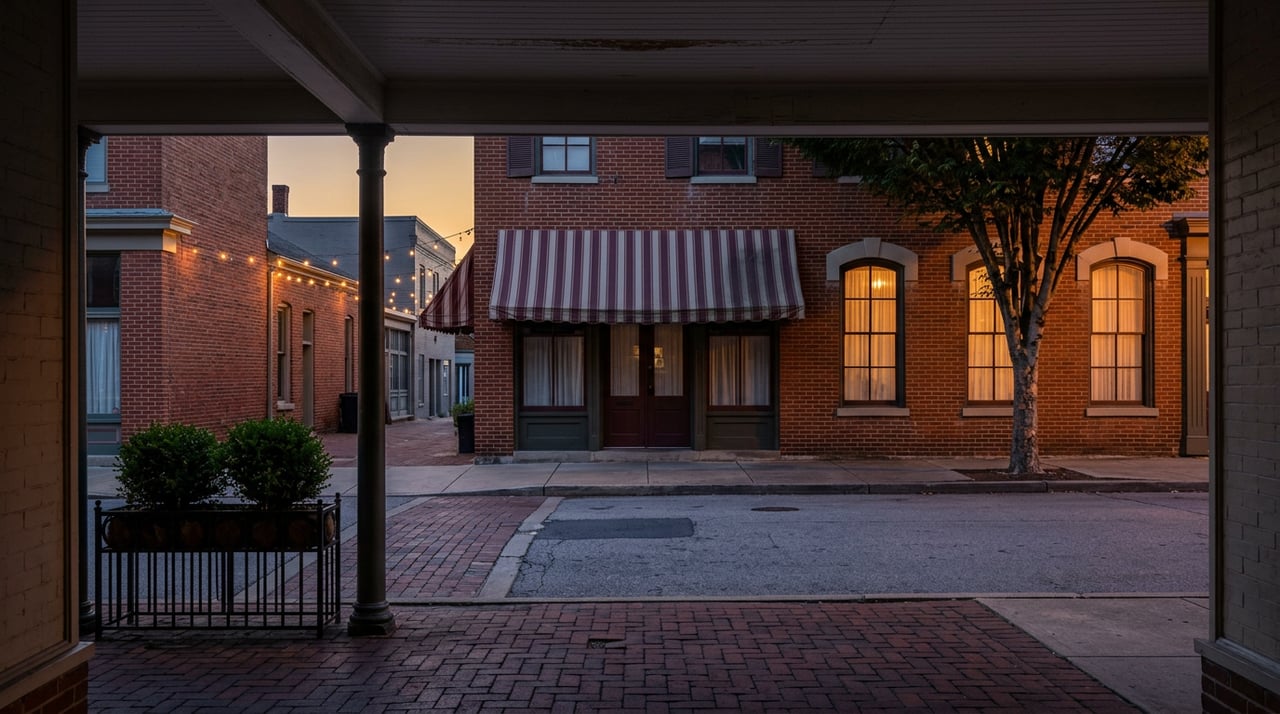
Walk the Decatur Square at 7:30 on a Saturday morning and you'll find the same crowd that's been showing up for years: contractors grabbing biscuits before a job, retirees working the crossword at a corner table, a line forming at Western Egg before the courthouse bell even finishes its first toll. Come back at 7:30 that same evening and the square has become a different place entirely. Cocktails are moving, the patio at Trinity Street is full, and somebody's ordering the Chilean sea bass under string lights strung across a storefront that used to be a coffee shop that used to be something else.
That's the thing about the square that doesn't show up in the generic "things to do in Decatur" roundups. It isn't one downtown. It's two, stacked on the same four blocks, running on different clocks, serving different versions of the same community. If you've lived here a while, you already feel this without naming it. Naming it changes how you use the place.
The morning and lunch economy on the square is the one that's been here the longest, and it hasn't needed reinventing because it never stopped working. Western Egg does what a breakfast counter in a courthouse town is supposed to do. Whistle Stop Cafe and Dunn Rite Cafe carry the same job for the lunch crowd, the kind of places where the server knows your order before you sit down. Rooster's Roadhouse and Cherry Pie & Co round out the daytime rotation, and if you're craving something with more smoke on it, North Texas Smoke and Catfish O'Harlies handle that end of the menu without much fanfare.
This is the square's steady pulse. It's not aimed at visitors and it's not trying to be a destination. It's aimed at people who have somewhere to be at 1 p.m. and want lunch that doesn't take an hour. That's a different design problem than the one the evening side of the square is solving, and it's worth sitting with that difference for a second, because it explains why the square feels calm at noon and busy at eight.
The clearest evidence of the square's split personality is a single address that's reinvented itself twice in the last several years. Before it was anything else, the space now home to Trinity Street was a concept called Roastaruant, launched right before COVID hit and shut down not long after, a casualty of the same staffing and market pressures that closed a lot of ambitious small openings in 2020. Owner Matt Fisher didn't abandon the corner. He rebuilt it as Trinity Street Coffee Bar, a craft cocktail and coffee spot that became a genuine fixture on the square. Then, rather than stand still, he expanded again, turning the adjoining space into a full dinner restaurant that opened in April 2024 with a menu built around steak and Chilean sea bass alongside more affordable appetizers, explicitly modeled on the kind of "elevated Southern" experience Fisher compared to Fort Worth's Reata while insisting it stay approachable for families.
That's not a footnote. That's the clearest evidence that the square's evening economy is a genuinely newer layer than its daytime one. A restaurant that shut down, came back smaller, then came back again bigger, on the same corner, is a small case study in what it takes to build a dinner-and-cocktails destination in a town whose square was built around a courthouse, not a nightlife district. The Decatur City Council even approved a historic overlay signage variance so the new concept's exterior lettering could match the consolidated brand, which tells you the city itself has been actively accommodating this shift rather than just tolerating it.
If you measure the square only by its oldest businesses, you'll miss this. The day shift tells you what Decatur has always been. The night shift tells you what it's becoming.
None of this happens in a vacuum. The square sits inside a town that still organizes its outdoor life around a handful of named parks rather than a sprawling trail network, and that's part of what keeps the pace here different from bigger North Texas suburbs. Kenny Renshaw Park, a 13.5-acre spot off South FM 51, is the default choice for a real walk or run, with a paved trail that loops past soccer and softball fields and a covered pavilion, and it's dog-friendly as long as you clean up after your own. Closer to downtown, Harmon Park and Melba Doyle Park are smaller, quieter options, the kind of green space you use before work rather than plan a whole outing around.
None of these are marketed as scenic attractions and none of them need to be. They're functional, close, and used the way small-town parks are supposed to be used, which is often and without much ceremony. That's a different value proposition than a destination trail system, and it matches a square built for daily use rather than tourism.
The square's identity gets reinforced every year by events that aren't trying to reinvent anything, and that consistency is part of the point. The Wise County Youth Fair, run by a 501(c)(3) built specifically for the county's young people, has anchored livestock judging and agriculture programming here for more than seven decades. The 2026 edition ran from February 26 through March 7, filling the Wise County Fairgrounds with horse shows, 4-H judging, and public speaking events held at the Decatur Church of Christ, the kind of civic infrastructure that only exists because a community keeps showing up for it year after year.
Further out on the calendar, the Decatur Chamber of Commerce runs its Eighter Food Truck Challenge, one of several recurring chamber events alongside the Tree Lighting Ceremony and Parade of Lights that give the square a reason to fill up outside of normal business hours without needing a permanent new restaurant to do it. And every year since 1881, during the last full week of July, the town has hosted the Wise County Old Settlers Reunion, a tradition old enough that it predates most of the buildings currently standing on the square, including the Wise County Courthouse itself. That courthouse, designed by James Riely Gordon, the architect responsible for more Texas courthouses than almost anyone else, is listed on the National Register of Historic Places and still functions as the literal and symbolic center around which everything else on the square gets arranged.
That combination, a 145-year-old reunion tradition next to a restaurant concept that's barely two years into its current form, is the square in miniature. Nothing here is static and nothing here is disposable. The oldest institutions keep going because they still work, and the newest ones earn their place by adding something the square didn't already have.
The mistake in most write-ups of small Texas courthouse towns is treating the square as either preserved-in-amber history or a blank canvas for reinvention, as if it has to pick one. Decatur's square does both at once, and that's the actual insight here. The morning counter crowd and the evening cocktail crowd aren't competing for the same four blocks. They're using the same four blocks for different purposes, at different hours, and the square is large enough and old enough to hold both without contradiction.
If you live here, you've probably felt this without ever laying it out this way. The next time you're deciding whether to grab lunch at Whistle Stop or dinner at Trinity Street, you're not really choosing between two restaurants. You're choosing which version of the square's rhythm you want to join for the next hour, and either one will feel exactly like home.
If you're weighing a move within Wise County, or just curious what a property near the square is actually worth in today's market, Kaki Lybbert has spent nearly three decades getting to know these streets from the ground up. Let's Connect.
Known for her integrity, experience, and deep commitment to her clients and community, Kaki Lybbert has become a trusted name in North Texas real estate. Whether helping families buy or sell a home, mentoring other REALTORS®, or advocating for the future of the profession, Kaki brings the same dedication, leadership, and heart that have defined her career for nearly three decades.